
General Considerations While Using Jet Patcher
Jet Patching (Velocity Spray Injection Patching) is an advanced, high-velocity pneumatic repair technology utilized for rapid maintenance of bituminous pavements. Operating under high compressed air pressure (typically 5 to 7 bar), the system cleans, primes, aggregates, and seals pavement distresses in a single continuous operation. However, to ensure long-term structural integrity and compliance with IRC:82-2023 guidelines, essential field considerations must be strictly implemented.
1) Large Potholes shall be excavated in rectangular box then only it should be filled with Course aggregates followed by Fine aggregate mixes. For these purpose if the Jet Patcher itself has mechanism to cut the road and have storage capacity of course aggregates separately then it can be very effective machinery to fill potholes. In accordance with MORT&H Section 3004, deep potholes (>50 mm depth) demand a step-down aggregate structural matrix. High-velocity pneumatic delivery ensures complete filling of micro-voids, but structural shear transfer at vertical boundaries requires neat vertical edges cut with diamond saws or integrated hydraulic milling heads. Laying coarse aggregates (10 mm to 20 mm nominal size coated with cationic rapid-setting bitumen emulsion RS-1 or MS) followed by a fine matrix (4.75 mm down to 2.36 mm aggregate) establishes structural interlock and prevents post-compaction rutting under dynamic axle loads.

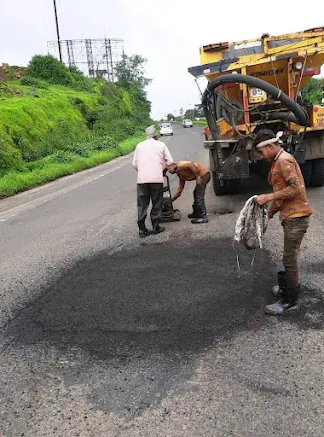
2) Large Potholes requires Rolling or Tapping for proper compaction of mix filled. Although velocity spray injection achieves initial mechanical compaction through high-blast impact (particle velocity exceeding 30 m/s), high-volume or deep repairs exceeding 75 mm depth must be placed in lifts. Supplemental mechanical compaction using lightweight vibratory plate compactors (80-100 kg) or small tandem rollers ensures maximum target density (>95% of Marshall density), eliminating secondary consolidation under heavy commercial vehicle traffic.

3) After filling Potholes, Traffic shall not be allowed immediately, as mix filled in pothole requires curing period. Cationic Bitumen Emulsion (RS-1 / CQS-1h) relies on chemical breaking (separation of water phase from bitumen droplets) and subsequent moisture evaporation. Premature traffic exposure under high shear forces strips uncured aggregate particles. Depending on ambient relative humidity and temperature, a minimum curing window of 15 to 45 minutes is mandated, or a dry aggregate top-cap (3 mm dust screening) must be applied to prevent vehicle tire pick-up.
4) For further improvement, emulsion seal coat can be very effective. Applying a final spray layer of modified bitumen emulsion topped with clean 2.36 mm to 4.75 mm aggregate chips (Choke Aggregate) seals surface micro-voids against water ingress, effectively raising resistance against stripping, raveling, and freeze-thaw degradation.
5) As long as possible potholes shall be filled when they are smaller in size, it will help in low material consumption as well as reducing Accidents due to potholes. Proactive routine maintenance prevents progressive pavement fatigue. Small isolated depressions consume minimal aggregate-emulsion volume and prevent water infiltration into subgrade layers, preserving structural California Bearing Ratio (CBR) values and significantly minimizing road safety hazards.
6) If Jet Patcher is improved to fill Alligator crack type 1 and 2 like distresses, the formation of Potholes can be prevented upto considerable level. High-pressure air blasting clears fine debris and vegetation from fatigue cracks (Alligator Cracking). Injecting polymer-modified bitumen emulsion (PNB/CRMB) directly into 3 mm - 10 mm crack networks seals subbase layers, arresting structural breakdown before localized shear failure turns cracks into full-depth potholes.
7) If Storing capacity of Jet Patcher is improved then large stretches can be covered in single trip enabling regular/daily maintenance of roads. Expanding onboard hopper capacities (to 8-10 m³ aggregate) and emulsion tanks (to 2,000-3,000 Liters) optimizes operational logistics, turning velocity patching into a continuous highway corridor maintenance system capable of servicing 15-20 lane-kilometers per day.
Other Distresses in pavement are mentioned in another Topic → Click here for topic Link
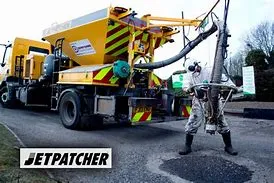
Some Advantages of Jet Patcher Method over Conventional Method
| Parameters | Conventional Method | With Jet Patcher |
|---|---|---|
| Manpower | Wastage of 30% to 40% manpower as they sit idle till Bitumen gets heated. Requires large manual crews (8-12 workers) for manual excavation, heating, asphalt transport, spreading, and raking. | Hardly any idle time. Operated fully hydraulically via a single-operator cabin joysticks or 2-person crew, dramatically reducing manual labor exposure to live traffic. |
| Material |
Wastage of Material 1) Bitumen :- Use in Heating, Wastage in Heating Tin, Wastage in Pouring (which spills Outside of potholes) 
2) Aggregates :- Wastage in many places, No proper bitumen covering fails entire purpose sometimes |
Less wastage. Automated metering systems precisely match aggregate delivery with emulsion spray volume at the nozzle tip, guaranteeing 100% aggregate coating without excess bitumen runoff or unbound material loss. |
| Compaction | In Both Cases compaction is required, I think Jet Patcher machine (Which I have seen) don't have its own compaction mechanism. While high-velocity impact air delivery (30+ m/s) forces aggregates into micro-cavities for shallow patches, structural repairs >50mm depth require supplementary compaction via plate compactors or small tandem rollers for both methods to prevent settlement under heavy traffic. | |
| Cost | Comparing Above Parameters, for same quantum of Work, conventional method can be costly due to high fuel usage for hot-mix transport, excessive manual labor bills, high material waste, and frequent patch failure rework. | Comparing Above Parameters, for same quantum of Work, this method can be cost effective. Delivers a 30% to 45% reduction in lifecycle cost per patch due to cold-emulsion operation, minimal crew overhead, and extended patch service life. |
| Time | Time consuming Method 2-3 Tonnes consumption per day. High traffic disruption; requires manual jackhammering, tack coating, hot-mix dumping, and long traffic blockages (lane closures exceeding several hours). | Fast Method 5-6 Tonnes, Unload Time 5-6 Hours. Complete repair cycle takes 3 to 5 minutes per standard pothole. Lanes can be reopened to moving traffic almost immediately after aggregate top-dressing. |
Research Insights on Jet Patcher
Velocity Spray Injection Patching (Jet Patching) represents a paradigm shift in pavement preservation engineering. Combining high-velocity compressed air cleaning, automated tack coating, force-feed aggregate coating, and protective top-sealing into a single mobile platform, it provides a high-performance solution for flexible pavement defects. Key technical data and field evaluations include:
- Productivity & Operational Efficiency: Field evaluations by the Federal Highway Administration (FHWA) show velocity spray injection patchers repair 50 to 100 potholes per operational day. A single machine processes 5 to 8 tonnes of material daily, reducing individual repair cycles to 3–5 minutes per pothole compared to 30+ minutes required for traditional cut-and-fill hot-mix repairs.
- Cost Savings & Waste Reduction: Life-cycle cost analysis from Jetpatcher Corp and state DOTs demonstrates a 30% to 40% reduction in repair expenditure per square meter. Mechanized delivery reduces crew requirements down to 1-2 operators and cuts aggregate/emulsion waste by up to 30% through precise metering at the mix delivery nozzle.
- Engineering Advantages: Enables all-weather repairs (operable in damp or cold ambient conditions down to 5°C, unlike hot-mix asphalt). High-velocity air blasting removes loose detritus and moisture from the pothole base, creating a superior mechanical bond. Field tracking records a patch service lifespan ranging from 2 to 5 years.
- Technical Limitations: Equipment involves high initial capital investment ($150,000–$300,000 per unit). Operational reliability requires trained technicians for hydraulic and pneumatic maintenance. It is optimized for localized surface distresses and is not a substitute for full-depth structural base failure rehabilitation.
- India Usage & IRC/CRRI Guidelines: National Highways Authority of India (NHAI) and state PWDs specify velocity patchers under IRC:82-2023 and IRC:SP:100. Central Road Research Institute (CRRI) research shows nano-modified cationic emulsion formulations improve aggregate adhesion, increasing wet-stripping resistance and raising soaked CBR stability by 20%–30%.
- Global Case Studies: Highway maintenance reports across the UK, Australia, and North America show a 40% reduction in cost per repaired distress and a 3x speed increase over manual cut-and-tack cold mix methods, significantly lowering road worker exposure to traffic hazards.

 Posts
Posts


0 Comments
If you have any doubts, suggestions , corrections etc. let me know