
Slope Management in Hill Roads and Landslides
Hill Slopes across Highways – Classification
- A) Based on height
- B) Based on slope inclination & presence of overhangs
- C) Based on Geological classifications
Definition of Hill Slopes across Highways
- Convex slope segments – commonly occur in upper parts of soil mantled slopes, near drainage divide
- Straight slope segments – dominated by mass movement processes
- Talus slopes – debris piles up to characteristic angle of repose; adjusts by movement when new debris is added
- Concave slopes – common where overland-flow runoff transports sediment from upper slopes
- Virgin slopes
- Highway cut slopes
- Manmade slopes
Components of Hill Slope across Highways
Geological, Geomorphological, Geohydrological, Geotechnical, Ecological/Environmental Interactions and Interrelationships between Slope Components
Investigations of Hill Slopes & Processes

Geological Investigations – Type of material, structures
Identification of material:
A) Soil Strata
- Sandy soil
- Clayey soil
- Residual soil
- Talus
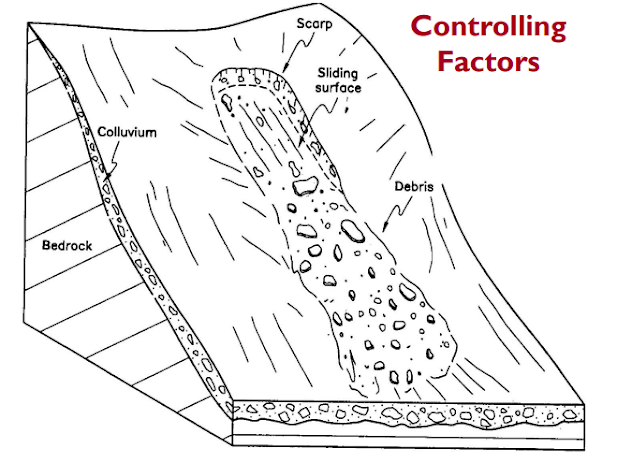
- Colluvium
- Moraines, glacial
- Alluvium, Loess
B) Rocky Strata
- Type of Rock
- Weathering extent
- Joint pattern, Joints, Faults, Folds, Fractures
C) Mixed Strata
- Mix of soil + boulders
- Properties and classification
Geomorphological Investigations
Type of slope, steepness and various features on the slope
Micro and macro features of morphology:
- Erosion of slope
- Presence of streams
- Presence of waterfalls
- Presence of vegetation
- Extent of Erosion
- Piping phenomenon
Geohydrological Investigations
- Drainage network, springs, Rivers etc.
- Surface and Sub-surface Drainage Investigations
- Watershed Management
Geotechnical Investigations
Strength properties of the material
Seismic Refraction Tomography (SRT): Utilizes refraction of seismic waves on geologic layers to characterize subsurface conditions and geologic structure. Shots at surface, recordings via geophones.
Natural Phenomena that can Trigger Landslides
- Earthquakes, volcanic eruptions, seismic shaking
- Intense rainfall, rapid snowmelt, glacier melting, changes in water level
- Stream/coastal erosion and natural dam failure
- Rising groundwater or increase of pore water pressure
- Undercutting of cliffs and banks by water erosion (tidal waves)
- Anthropogenic action
Highway Hill Slope Vulnerability and Risk Assessment
- Highway hill slope rating system
- Rating criteria for identification and classification of highway slopes
- Suitability/vulnerability and potential for hill slope failure
- Zonation of slopes – based on vulnerability classes (methods & applications)
Identification / Estimation / Calculation of Risk due to Vulnerable Highway Hill Slopes
Terrain / Slope Inventory
- Man-made slopes
- Natural slopes
- Rock slopes

- Debris slopes / Block Slopes

- Soil slopes

- Composite slopes
- Bedding controlled slopes
- Rock slopes
Important Factors / Features
- Geology – Discontinuities, Shear zones, Faults, Slickensides, Weak materials, Colluvium, Alluvium, Ancient landslide
- Slope morphology, Drainage morphology, Vegetation type, Slide type
- Micro features: Cracks/fractures/subsidence, Sinking/cavities, Bulging, Deformed ground, Break in slope, Hummocky ground
- Hydrology: Slope hydrology, Catchment, Ephemeral drainage, Topography vs Drainage flow, Scouring/Erosion

- Geohydrology: Perched groundwater flow, Water table, Streams/springs
- Landslides: Active/dormant, Debris flow
 , Rockfall, Slumps, Slides, Subsidence
 - Infrastructure: National Highway, SH-MDR-VR, Railways, Irrigation Canals, Dams etc.
Highway Hill Slope Protection Structures (Construction & Maintenance)
Stabilization of Slopes
- Excavation at Top of Slope
- General Flattening of Slope
- Benching of Slope
- Complete Removal of Unstable Mass
- Earth Fill / Rock or Gravel Fill at Toe of Slope
- Replacing Existing Soil with Low density material e.g. Geofoam
- Application of Geosynthetics
Selection of Structures for Protection
- Debris Arrestors
- Retaining Wall (PCC wall section Calculator)
- Rock and Earth Fill Buttress at Toe
- Cribs or Gravity Retaining Wall
- Breast Wall, Toe Wall
- Pile Walls
- Benching, Filter beds, Easing of Slopes
- Bitumen/Asphalt mulching, Chutes and Sloping Aprons, Turfing
- Caisson Toe of Slope
- Barriers at Toe anchored by Tie-Back Method
- Increase of Shear Strength: Soil Cementation, Freezing, Electro-Osmosis
- Compaction, Rock Bolting, Blasting at Toe
Note: Maintenance of slope protection structures is equally important.
→ Drainage System (detailed article)
Attributes / Factors for Slope Management Inventory
- A – Location
- B – Age of cutting
- C – Type of slope
- D – Mode of failure
- E – Type of lithology
- F – Thickness of soil/debris on affected slopes
- G – Thickness of overburden
- H – Vegetation on affected slope
- I – Vegetation above / beyond affected slope
- J – Height of cutting
- K – Slope of cutting
- L – Cut slope angle vs. Uphill natural slope
- M – Water conditions
- N – Deformation characteristics (cracks/subsidence/failure)
- O – Joint sets
- P – RMR (rock slope)
- Q – Direction of bedding plane / foliation
- R – Natural Drainage Preservation
- S – Type of Road (Expressway, NH, SH, MDR, ODR, VR, NP etc.)
- T – Number of Road
- U – Chainage of Landslide location
Brief List of Remedial Measures for Unstable Slope
Modification of Slope Geometry
- Removing material from driving area (with possible lightweight fill substitution)
- Adding material to maintaining area (counterweight berm/fill)
- Reducing general slope angle
Drainage
- Surface drains to divert water
- Shallow/deep trench drains with free-draining geomaterials
- Buttress counterforts (hydrological effect)
- Vertical boreholes (pumping / self-draining)
- Sub-horizontal / sub-vertical boreholes
- Drainage tunnels, galleries, adits
- Vacuum dewatering, Siphoning, Electro-osmotic dewatering
- Vegetation planting (hydrological effect)
Retaining Structures
- Gravity retaining walls, Crib-block walls, Gabion walls
- Passive piles, piers, caissons
- Cast-in-situ reinforced concrete walls
- Reinforced earth structures (strip/sheet – polymer/metallic)
- Buttress counterforts (mechanical effect)
- Retention nets, Rockfall attenuation systems (ditches, benches, fences, walls)
- Protective rock/concrete blocks against erosion
Internal Slope Reinforcement
- Rock bolts, Micro piles, Soil nailing, Anchors
- Grouting, Stone/lime cement columns
- Heat treatment, Freezing, Electro-osmotic anchors
- Vegetation planting (root strength mechanical effect)


 Posts
Posts


0 Comments
If you have any doubts, suggestions , corrections etc. let me know