

Distresses in Pavements and Probable Repair Remedies
Summary of Distresses
| Type of Distress | Symptoms | Probable Cause | Possible Treatment |
|---|---|---|---|
| Surface Defects | |||
| 1. Fatty Surface | Collection of binder on surface | Excessive binder in premix, spray or tack coat; loss of cover aggregates; excessively heavy axle loads | Sand blinding; open-graded premix; liquid seal coat; burning off excess binder; removal of affected area |
| 2. Smooth Surface | Slippery | Polishing of aggregates under traffic or excessive binder | Resurfacing with surface dressing or premix carpet |
| 3. Streaking | Presence of alternate lean and heavy lines of bitumen | Non-uniform application of bitumen or application at low temperature | Application of new surface |
| 4. Hungry Surface | Loss of aggregates or presence of fine cracks | Use of less bitumen or use of absorptive aggregates | Slurry seal or fog seal |
| 5. Bleeding of Asphalt | Slippery | Excess of asphalt while mixing | Sand blinding |
| Cracks | |||
| 1. Hairline Crack | Short and fine cracks at close intervals on the surface | Insufficient bitumen, excessive filler, or improper compaction | Treatment depends on whether pavement is structurally sound or unsound. For structurally sound pavements, fill cracks with low-viscosity binder, slurry seal, or fog seal depending on crack width. Unsound cracked pavements require strengthening or rehabilitation treatments. |
| 2. Alligator Cracks | Interconnected cracks forming a series of small blocks | Weak pavement, unstable subgrade or lower layers, excessive overloads, or brittleness of binder | |
| 3. Longitudinal | Cracks in straight line along the road | Poor drainage, shoulder settlement, weak joint between adjoining spreads of pavement layers, or different frost heaves | |
| 4. Edge Crack | Crack near and parallel to pavement edge | Lack of support from shoulder, poor drainage, frost heave, or inadequate pavement width | |
| 5. Shrinkage Cracks | Cracks in transverse direction or interconnected cracks forming large blocks | Shrinkage of bitumen layers with age | |
| 6. Reflection Cracks | Symptomatic cracks over joints and cracks in underlying pavement | Due to joints and cracks in the underlying pavement layer | |
| Deformation | |||
| 1. Slippage | Formation of crescent-shaped cracks pointing in direction of wheel thrust | Unusual wheel thrust, lack or failure of bond between surface and lower courses | Removal of surface layers in affected area and replacement with fresh material |
| 2. Rutting | Longitudinal depression in wheel tracks | Heavy channelized traffic, inadequate compaction, poor stability of materials, or heavy bullock cart traffic | Filling depressions with premix material |
| 3. Corrugations | Formation of regular undulations | Lack of stability in mix, vehicle spring oscillations, or faulty laying of surface course | Scarification and relaying of surfacing, or cutting high spots and filling low spots |
| 4. Shoving | Localized bulging of pavement surface along crescent-shaped cracks | Unstable mix, lack of bond between layers, heavy start-stop movements, or negotiation of curves/gradients | Removing material up to firm base and relaying a stable mix |
| 5. Shallow Depressions | Localized shallow depressions | Presence of inadequately compacted pockets | Filling with premix materials |
| 6. Settlements and Upheaval | Large deformations of pavement | Poor compaction of fills, poor drainage, inadequate pavement strength, or frost heave | Excavate and redo weak fill; strengthen pavement if inadequate strength is the cause |
| Disintegration | |||
| 1. Stripping | Separation of bitumen from aggregates in presence of moisture | Hydrophilic aggregates, inadequate mix composition, continuous water contact, poor bond, poor compaction | Spread and compact heated sand (for surface dressing); replace with fresh bituminous mix containing anti-stripping agents (other cases) |
| 2. Loss of Aggregates | Rough surface with loss of aggregates in some portions | Ageing/hardening of binder, stripping, poor bond, insufficient binder, brittleness | Application of liquid seal, fog seal, or slurry seal depending on damage extent |
| 3. Raveling | Failure of binder to hold aggregates, shown by pock marks or coded areas | Poor compaction, poor bond, insufficient binder, brittleness | Application of cutback covered with coarse sand, slurry seal, or premix renewal coat |
| 4. Pot-Hole | Bowl-shaped holes, usually after rain | Ingress of water, lack of bond between surfacing and WBM base, insufficient bitumen | Filling with premix material or penetration patching |
| 5. Edge Breaking | Irregular breaking of pavement edges | Water infiltration, poor lateral support from shoulders, inadequate edge strength | Cut affected area into regular sections and rebuild; simultaneously construct proper shoulders |
Timely identification and appropriate repair of pavement distresses significantly extend service life, improve safety, and reduce long-term maintenance costs. Always ensure proper drainage and use anti-stripping agents where moisture is a concern.
Types of Pavement Failures and Distresses
1) Structural Failure
Collapse of pavement components of such magnitude that the pavement becomes incapable of sustaining imposed traffic loads.
Factors Responsible for Structural Distress
a) Preparation of Foundation
i) Strength
Even with macadam or asphalt base courses, insufficient foundation strength leads to failure under transmitted traffic stresses. Weak areas often show a crazed crack pattern.
Newly constructed flexible pavements may hide weaknesses due to non-uniform grading, clay pockets, or inadequate compaction. A practical test involves driving a roller (equivalent to surfacing weight) over the foundation and noting deflections. However, this does not replicate repetitive traffic loading or detect design flaws.
Weaknesses must be remedied by replacing unsound material or providing adequate pavement thickness relative to subsoil bearing capacity.
ii) Shape
Mixture composition and layer thickness are interrelated—thicker layers require larger aggregates. Foundations must be regular transversely and longitudinally, involving filling depressions or removing high spots.
Low areas should be raised with material from the same temperature group. Nominal aggregate size depends on fill depth; multiple grades may be needed for deeper sections.
High spots can be treated by scarifying or breaking out with compressors.
iii) Permeability
Porous foundations combined with open-textured surfacing allow water percolation, weakening the subgrade. Proper surface dressing prevents this.
iv) Compaction
Mixtures require proper compaction for satisfactory performance under traffic. Steel-wheeled and pneumatic-tyred rollers reduce voids, with bitumen acting as a lubricant. Viscosity at rolling temperature is critical, influenced by filler content and aggregate shape/texture.
- Density standards are achieved through rigorous lab testing. Asphalt concrete must meet specified density and void limits.
- Specifying roller numbers based solely on tonnage/area is misleading; rolling temperature and material type govern effectiveness. Trial patches determine optimal rolling temperatures.
- Heat loss depends on thickness, wind, and air temperature. Sufficient roller capacity ensures compaction within temperature limits.
- Roller procedure: Longitudinal forward/reverse passes with slight overlaps, varying pass lengths to avoid surface marks. Continuous movement prevents indentations.
- Three-wheeled rollers start with rear rollers; narrow rollers risk hard-to-remove indentations.
- Field trials and core tests establish qualitative compaction standards—continue rolling until no further reaction and uniform texture.
b) Shear
Occurs when cohesion and internal friction are insufficient in the base/subgrade. Characterised by upheaval outside wheel paths and surface cracking.
Often due to poor shear strength of pavement mixes. Proper shoulder design reduces edge failures.

Edge Breaking: Pavement edges break due to lack of shoulder support or heavy edge tracking.
Longitudinal Cracks: Single or multiple cracks parallel to the centerline, caused by horizontal movement from lack of friction or differential settlement of plastic subgrades.
c) Consolidation
Surface distortion from consolidation of paving layers, leading to rutting in under-designed pavements. Primarily occurs in subgrade, less in base.
d) Cracking
Causes:
- Structural failure (rutting without adjacent upheaval – consolidation of lower layers)
- Rolling too hot
- Excessive water on roller wheels
- Reflection from underlying layers
- Fatigue damage
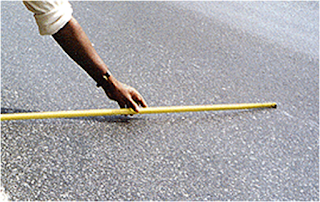
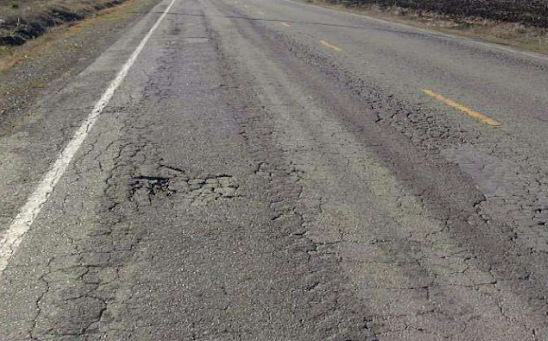
Types of Cracking:
- Cracking without pattern
- Cracking of unstable mix
- Reflection cracking (regular pattern from underlying rigid/semi-rigid base)
- Alligator cracking
Class I Alligator Cracking: Interconnected cracks forming a map pattern; edges not raised/spalled, no rocking under load (fatigue from resilient base/subgrade).

Class II Alligator Cracking: Interconnected cracks; edges raised/spalled, pieces rock under load (severe distress, structural inadequacy, or shrinkage/swelling soils like black cotton soil).

Observe for one full seasonal cycle before applying crack filler or slurry.
e) Adverse Groundwater Conditions
High groundwater weakens subgrade, causing localised failures even in otherwise satisfactory pavements. Remove water at source; minor resurfacing offers only temporary relief.
Pot-Holes
1) Isolated Pot-Holes: Local distress, soft spots, or water entrapment.

2) Pot-Holes Associated with Cracking: Cracked pieces dislodge under traffic; severe distress, end-of-life pavement, structural inadequacy, lack of binder, excessive voids, poor drainage.
Pot-holes are highly dangerous and require immediate repair to prevent further deterioration.
f) Heating and Drying
Aggregate storage conditions affect drying efficiency. Wet or recently washed aggregates are hardest to dry and heat, impacting mix quality.
2) Functional Failure
Pavement cannot perform its intended function without inducing excessive stresses in vehicles due to surface roughness, despite no structural collapse.
Functional Failures
a) Surface Defects
- Segregation: Poor mixing/rolling or excessive hand raking creates density/permeability variations.
- Dragging: Open texture laterally; caused by insufficient thickness or high paver speed.
- Weathering: Dry, oxidised appearance from old surfacing or insufficient bitumen.
- Bleeding: Excess bitumen on surface (wheel paths); too much/soft bitumen.
b) Accumulation of Binders
Excess binder from previous dressings softens new layers. Remove by heating/planing before overlay.
c) Joint Failures
Poorly filled or raised joint compounds exacerbate reflective cracking. Remove and refill with compatible fine material.
d) Adhesion Failure
Laying on wet, contaminated, or overly smooth surfaces leads to slippage/stripping under traffic. Provide a key coat.
e) Temperature Issues
Low-viscosity base course bitumen can mobilise under hot surface course. Differential cooling causes stripping. Careful joint overlapping prevents textural differences.
f) Roughness
Incorrect rolling (temperature-sensitive materials) or paver issues (tamper wear, screed corrosion) cause uneven texture.
g) Ravelling
Loss of coarse/fine aggregates outside wheel paths.

Causes: Stripping, aggregate degradation, insufficient bitumen, bitumen oxidation.
General Causes of Pavement Distresses
- 1) Overloaded vehicles
- 2) High repetitions of loads
- 3) High tyre pressure
- 4) Climatic & environmental conditions (volume changes from wetting/drying, freeze-thaw)
- 5) Improper drainage – Saturated subgrade is the greatest enemy of pavement stability.
- 6) Disintegration of paving materials – Breakdown generates fines, loses interlock, accelerates pothole formation.
- 7) Poor construction practices – Subgrade rutting, dirty aggregates, inadequate control.
- 8) Lack of maintenance – Untimely crack/joint sealing allows water infiltration.
Quiescent load stress in potholes (dynamic impact):
Where $$h$$ can be expressed as $$h = \frac{V^2}{2g}$$ in terms of velocity.

0 Comments
If you have any doubts, suggestions , corrections etc. let me know