
Concrete Evaporation Rate Calculator
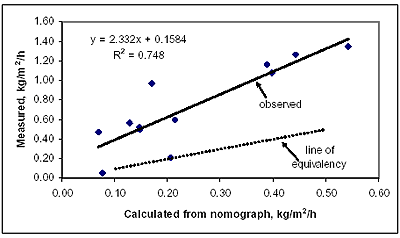
Based on Menzel Formula (NRMCA Nomograph – SI Units)
Menzel Formula
$$
W = 0.315 (e_o - e_a)(0.253 + 0.060V)
$$
Where:
- W = Evaporation rate (kg/m²/h)
- eₒ = Saturation vapor pressure at concrete temperature (kPa)
- eₐ = Actual vapor pressure in air (kPa)
- V = Wind speed (km/h)
Magnus Equation
$$
e_s = 0.61094 \times e^{\left(\frac{17.625T}{T+243.04}\right)}
$$
Used for calculating saturation vapor pressure.
Risk Interpretation
| Evaporation Rate | Risk Level | Interpretation |
|---|---|---|
| < 0.5 kg/m²/h | Low | Generally safe |
| 0.5 – 1.0 kg/m²/h | Moderate | Preventive measures recommended |
| > 1.0 kg/m²/h | High | High risk of plastic shrinkage cracking |
Why Evaporation Control is Important
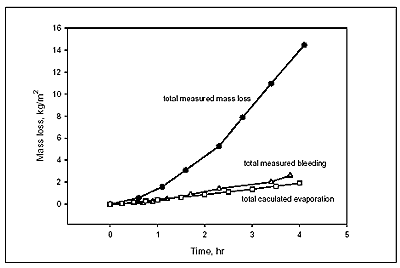
When evaporation rate exceeds bleeding rate, concrete surface dries rapidly causing plastic shrinkage cracking, crazing, reduced durability and poor finishing quality.
- High wind speed can be more dangerous than high temperature
- Low relative humidity sharply increases evaporation
- Bridge decks and pavements are highly vulnerable
- Hot weather concreting requires immediate curing measures
Recommended Preventive Measures
- Use fog misting or evaporation retardants
- Provide windbreaks and sunshades
- Reduce concrete temperature using chilled water or ice
- Schedule concreting during cooler hours
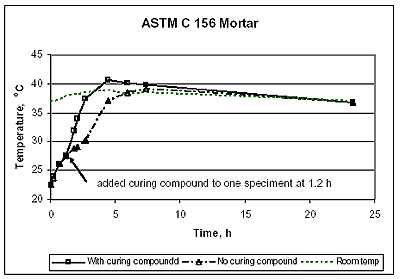
- Start curing immediately after finishing
NRMCA Nomograph References
References
- ACI 305R – Hot Weather Concreting
- NRMCA CIP-5 Plastic Shrinkage Cracking
- IS 7861 (Part 1) – Hot Weather Concreting
- Menzel Formula for Concrete Surface Evaporation


 Posts
Posts


0 Comments
If you have any doubts, suggestions , corrections etc. let me know